Growing creatures from geometry
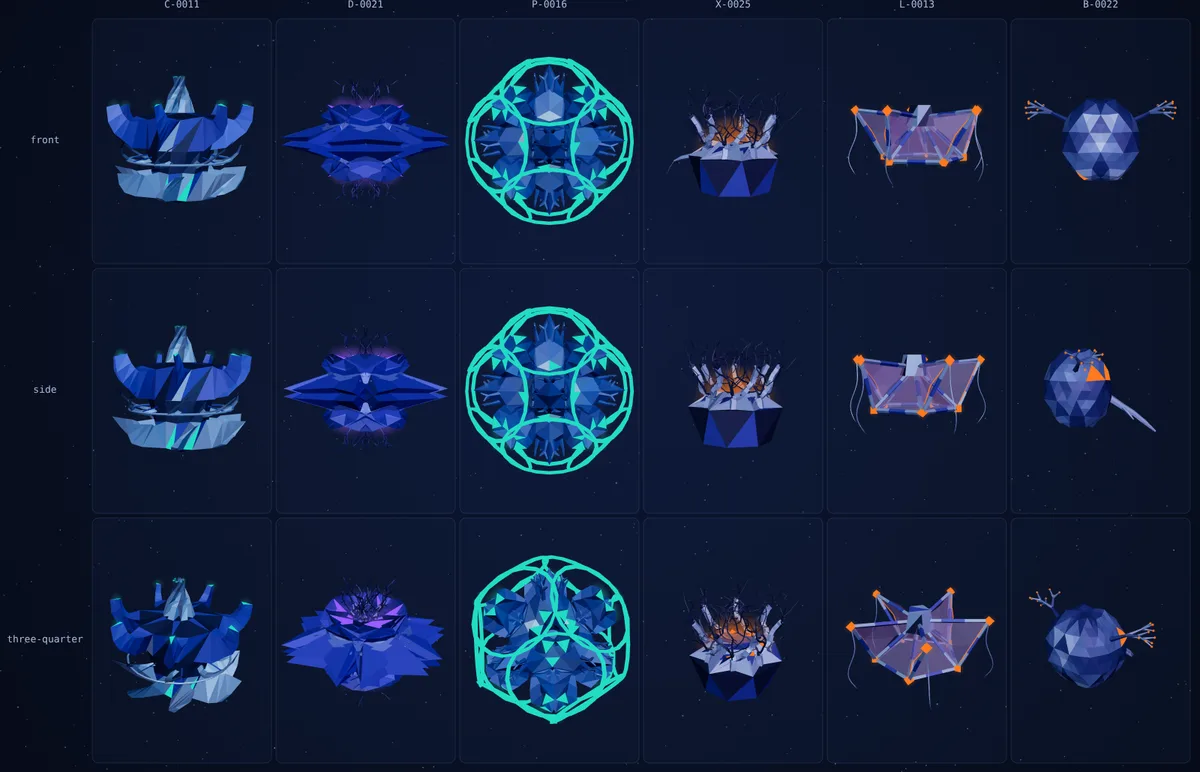
Space in Spaceaventura is not empty. Out in the currents there is life, and we are starting to meet it. This post is about how that life is made: the steps, the reasons, and what we believe a creature in a space game should be.
The rule we started from
Most space creatures in games and films are animals we already know, moved into space: whales that swim between stars, jellyfish that drift, worms that burrow, swarms with a queen. They are easy to read, and they are everywhere.
We set ourselves one rule: nothing borrowed. Not a shape, not a name, not a behaviour that another game or film already made its own. Before a creature joins the world, we check it against what exists.
So we do not start from animals. We start from shapes.
Step 1: a random seed shape
Every creature begins as a small random shape. The generator picks one of four kinds of start:
- A hull: a handful of random points, wrapped tight like cloth around pebbles.
- A cut stone: a solid shaped by slicing it with random flat cuts.
- A superformula shape: a single formula, found by the botanist Johan Gielis, that can draw stars, petals, squares and everything between by changing a few numbers.
- A sphere with bulges: a ball pushed outward in a few places.
Each start comes from a seed number, so the same number always grows the same creature.
Step 2: grow it, a few steps at a time
The shape then grows over three to six steps. Each step applies one rule:
- pull a face outward (extrude);
- grow a curling spike;
- branch like a plant, a little smaller at every fork;
- send out tendrils that reach towards points around the body (a method borrowed from how botanists model leaf veins);
- split faces and push them out by a smooth random field;
- stick small shards onto the surface;
- add a ring or a thin blade;
- twist, bend, cup, taper or swell the whole body.
Growth is the point. A creature that grows step by step looks like it has a history.
Step 3: hold it to a symmetry, or break it
Symmetry is what makes a shape look alive rather than like rubble. Each step is built once and then copied by a symmetry, so the whole body obeys it:
- Mirror symmetry: a left and a right side. It is the most familiar and the most dangerous, because the eye starts looking for a head.
- Turning symmetry: the same part repeated three, five or seven times around an axis, like a pinwheel. Odd numbers feel the least like anything we know.
- Turning with mirrors: four- or six-fold patterns that are also mirrored, like a snowflake.
- The symmetry of solids: the patterns of a tetrahedron, a cube or an icosahedron, with the same shape facing every direction.
- Broken symmetry: a perfectly symmetric creature that then gets two or three small random changes. One spike grows longer, one limb is grafted on. Suddenly it has a direction, and a past.
Step 4: a person chooses
The generator draws sheets of two dozen candidates. Anything that turns out to look like a known animal (a jellyfish, an octopus, an insect) is thrown away automatically or marked by eye. Then a person looks at the sheets and picks the ones that feel alive.
That last step matters most. The program proposes; people choose. A chosen shape can be grown further, or varied a dozen ways, until it is right.
Step 5: give it physics
A shape is not yet a creature. Each one we keep is matched to a real idea from physics, which explains how it lives:
- Something spinning drags space around with it. A body that dives in the right way can come out with more energy than it took in. Physicists call this the Penrose process.
- A wave bounced off something that spins fast enough comes back louder than it went in. This was shown in a laboratory in 2020.
- In space plasma, tangled magnetic field lines can suddenly snap and reconnect, releasing their stored energy at once.
A creature might feed, find its way or leap by one of these. Where we use real science, the creature's entry will say so in plain words and point to sources, so anyone curious can read more.
What we believe
- Original over familiar. If it reminds you of something from another game, we have not finished.
- True where we can be, honest where we cannot. Real physics is called real. Theories are called theories. And when a creature does something no law we know allows, we say so: which law it seems to break, and that nobody has studied it enough yet to explain how.
- Every creature has a job. Some are a spectacle, some show you where to look, some come with the weather. None is only decoration.
- Discovery belongs to players. Each pilot will keep a journal of what they have found, filled in as they meet each species: first a sighting, then a closer look, then what it does.
What comes next
We are choosing the first shapes now. Each one will get a name of its own, a place in a family tree of cosmic life, and a story. You will read them here first.